
Najmuddin A. Farooqi
Manager ( Retd )
New India Assurance
HEALTHCARE
A catch phrase “Smile you had a heart attack”, can be seen at the entrance of the chamber of arguably India’s best interventional cardiologist and a pioneer of transcatheter aortic valve replacement(TAVR) and he is none other than Padma Bhushan Dr.Ashok Seth, Chairman Fortis Escorts Heart Institute. The phrase means the person can survive and survive for long of a Heart attack ( Myocardial infarction ‘MI’ ) if the patient timely receives expert medical intervention. With the help of treatment the follow up medication dietary control prescribed exercises etc shall make the person live longer and a healthy life.
PRODROME & PRECAUTIONS
People should not ignore the warning symptoms just because they are young enough to have heart disease. Since, atherosclerosis (The build-up of fats, cholesterol and other substances in and on the artery walls) starts in youth which is a reminder that prevention should start early in life before problems develop.
Because coronary artery disease (CAD) is the cardinal cause of early heart attacks, it deserves greatest attention.
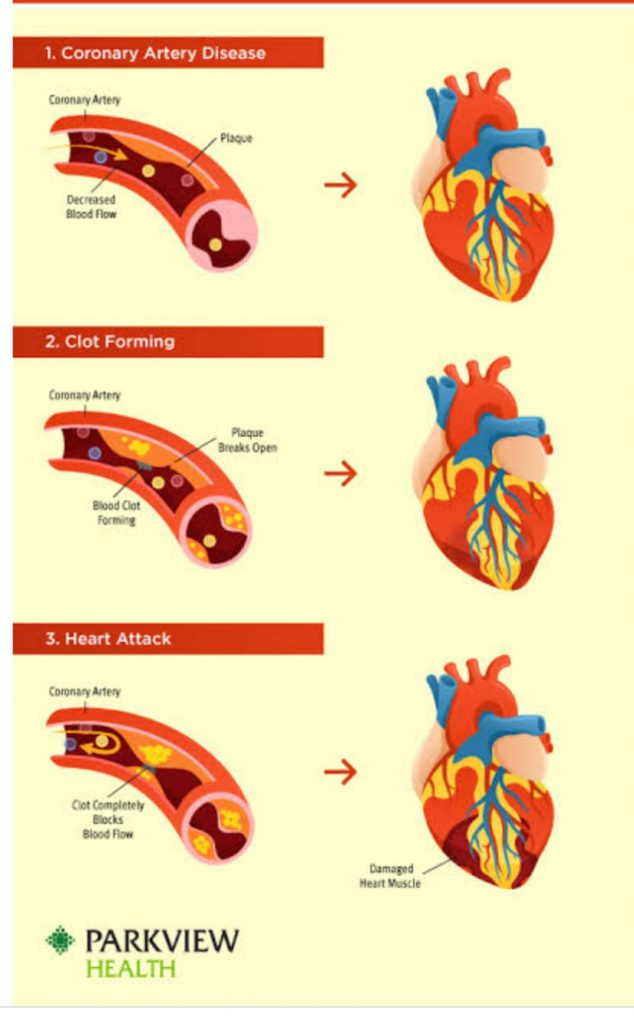
Surplus LDL cholesterol, enters the inner lining of arteries and gradually build up from tiny crystals into larger deposits later visible as fatty streaks. The arteries so damaged by smoking, high BP, or diabetes are particularly vulnerable .The atheromatous lesions within the blood vessels of the heart undergo changes ( intra plaque hemorrhage, erosion, ulceration, rupture, fissuring ) leading to thrombus formation blocking the vessel wall resulting in MI. 90% of the cases of heart attack are attributable to the above mentioned reasons.
The eventual result is deprivation of a portion of heart muscle of oxygen-rich blood. This kills muscle cells and produces a heart attack in minutes. Study of a person who is free of high cholesterol, smoking, diabetes, high blood pressure and obesity has remarkably low 5% risk of developing cardiovascular disease by age 95. In contrast, the risk for a man suffering with two or more of the above risk factors is 69%.
RISK FACTORS
————————
•Age ie. getting older
•Men are more susceptible to CAD risk, in women risk increases after menopause.
•Family history
•Smoking is a cardinal contributor to atherosclerosis
•Hypertension
•High cholesterol levels may increase the risk of formation of plaque & atherosclerosis.
•Type 2 diabetes and CAD share similar risk factors, such as obesity and high BP
•Physical inactivity or lack of exercise
•High mental stress.
•High triglycerides. This is a type of fat (lipid) in the blood.
•Use of alcohol
•Autoimmune diseases such as rheumatoid arthritis
PREVENTION
———————
Lifestyle and the habits will not only help treating CAD but shall also prevent it from developing in the first place. For good health of heart one should:
•Quit smoking
•Control conditions such as high BP, high cholesterol and diabetes
•Ensuring physical activity
•Take low fat, low salt diet eat fruits, vegetables and whole grains
•Maintain a healthy weight
•Reduce and manage stress
SYMPTOMS & COMPLICATIONS
———————————————
The most common and classic symptoms of a heart attack or Myocardial Infarction ( MI ):
•Chest pain in the middle or left pressure or tightness in the chest as if someone were standing on the chest, pain radiates to back, jaw
•Shortness of breath
•Sweating
•nausea/vomiting
•anxiety
•Usually in case of angina pain subsides within minutes after the stressful activity is stopped.
•breathlessness or extreme fatigue after exertion.
CAD can lead to:
•Heart attack; when a cholesterol plaque ruptures and a blood clot is formed, complete blockage of the heart artery may trigger an attack. The lack of blood flow may damage heart muscle. The amount of damage depends in part on how quickly one receives treatment.
•Heart failure; when some part of the heart is chronically deprived of oxygen and nutrients due to reduced blood flow, or if damaged by an attack, heart may become too weak to pump enough blood to meet body’s needs. This condition is known as heart failure.
WHEN TO SEE A DOCTOR
——————————————-
If suspecting to have a heart attack, immediately call 112/102 or local emergency number :
Rush instantly without wasting a minute to a nearest hospital preferably a heart centre. It is better to simultaneously take oral drugs nitroglycerin beta blockers thrombolytic/anti platelet agents and pain reliever.
If don’t have access to emergency medical services, have someone drive to the nearest hospital, self driving should only be a last resort.Tell the doctor the risk factors BP, high cholesterol, tobacco use, diabetes, family history etc.
DIAGNOSIS
——————-
The doctor will ask questions about patient’s medical history, do a physical exam, routine blood tests one or more diagnostic tests as well, including:
•Electrocardiogram (ECG): records electrical signals travel through the heart which often reveals evidence of a previous attack
•Holter: This is also ECG a portable monitor is tied to patient’s waist for 24 hours reveals the evidence during patient’s normal activities.
•Echocardiogram: uses sound waves to produce images of heart to know whether all parts of heart contribute normally to heart’s pumping activity.
•Stress ECG/TMT: If symptoms occur most often during walk/exercise doctor may advise for this test which is an ECG walking on treadmills
•Thallium stress: is a nuclear imaging test that shows how well blood flows into the heart. Radio-isotope administered in one of the veins, flows through bloodstream and ends up in the heart. Once the radiation is in the heart a special camera called a gamma can detect the radiation and reveal any issues related to heart muscles. Thallium stress is usually prescribed, suspecting heart isn’t getting enough blood flow when it’s under stress, in cases of previous heart attack or to check how well medicines are working to determine success of a procedure or surgery.
•Cardiac catheterization angiogram (Angiography): to view blood flow through heart, a special dye is injected into coronary arteries. This is known as an angiogram(x-ray photos) through a long, thin, flexible tube (catheter) that is threaded through an artery, usually in the leg, to the arteries in the heart. Dye so injected, figures out the narrow spots and blockages on the X-ray images.
TREATMENT
———————
In the first place treatment of coronary artery disease usually involves lifestyle changes.
Cardiologist decides whether patient requires conservative treatment i.e. standard medical treatment or less invasive procedures eg: PTCA, TAVR ( minimally invasive procedure for Valve replacement ) or Bypass surgery.
A. PERCUTANEOUS TRANSLUMINAL CORONARY ANGIOPLASTY( PTCA)
——————————————-
long thin tube (catheter) is inserted into the narrowed part of artery. Subsequently a wire with a flattened balloon is passed through the catheter to narrowed area. The balloon is then inflated, compressing the deposits against the artery walls, stent may also be left in the artery to help keep the artery open. Most of the stents gradually release medication to help keep the arteries open.
B. CORONARY ARTERY BYPASS GRAFT(CABG) SURGERY
——————————————-
a. Surgeon creates a graft to bypass blocked coronary arteries using a vessel from another part of body, allowing the blood to flow around the blocked coronary artery. Since this requires bypass surgery, it is mostly reserved for cases of multiple blocked or narrowed coronary arteries.
b. In so far as the minimally invasive surgeries, these are performed through small incisions in the right side of the chest, surgeons operate between the ribs, less pain and faster recovery in many cases
C. ENHANCED EXTERNAL COUNTER PULSATION(EECP):
———————————————-
the therapy is less known available in certain cities. EECP claims to have been a better non invasive alternate procedure for following patients:
Those who have underwent coronary artery bypass (CABG) or stents placed in the coronary arteries with ongoing angina or patients suffering from angina and have not undergone any such procedures in the past.
FOLLOW UP TREATMENT
——————————————
Post procedure/post hospitalization, follow up treatment and care is equally important i.e. dietary control, regular exercise, losing excess weight, stress management and taking regular medicines as per prescription which may include Anti Platelets, statins, Vasodilators, Niacin, Fibrates, Beta receptors/ Beta blockers, Diuretics etc.
Stop smoking which is a major risk nicotine constricts blood vessels carbon monoxide reduces oxygen in blood.
Approach only qualified and competent cardiologists. If any kind of intervention such as angioplasty or surgery is suggested, it is always better to consult more than one cardiologists/ surgeons. Enquire from the consultants if conservative or less invasive a better choice.
Nowadays cost of hospitalization expenses particularly in meeting the expenses of cardiac and other major illnesses become exuberantly high. One must have a health/ Mediclaim insurance policy with adequate sum insured covering all family members and dependants parents and/or parents in laws also.

