


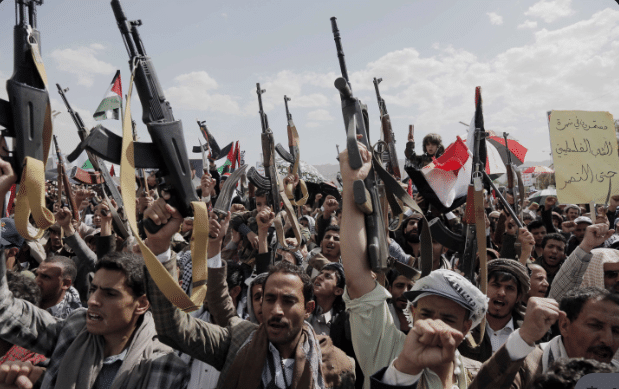
Iran War: Fighting Intensifies in Yemen as Hundreds Are Killed or Injured
SANA’A/TAIZ — October 3, 2026: Fighting has intensified dramatically across Yemen as the wider war involving Iran continues to reshape the regional battlefield. The latest escalation is centred particularly around Taiz and Yemen’s western coast, with Saudi-backed government forces and Iran-aligned Houthi fighters engaged in increasingly heavy clashes.
The scale of the latest violence is becoming clearer. Yemen’s internationally recognised government said its forces carried out 474 operations against Houthi positions in a 24-hour period, claiming that 1,540 Houthi fighters were killed or wounded. That figure is a claim by the Yemeni military and has not been independently verified.
The escalation comes after months of relative calm under the 2022 ceasefire. According to the Associated Press, the renewed fighting has already resulted in at least 838 deaths and more than 3,640 injuries, according to figures provided by the United Nations. More than 145,000 people have been displaced inside Yemen, while thousands more have crossed the Red Sea into Djibouti.
Taiz becomes a major battlefield
Taiz, one of Yemen’s most strategically important cities, has emerged as a major flashpoint.
Recent clashes have disrupted important roads connecting Taiz with Aden, while hospitals have struggled to cope with casualties. AP reported that Al-Thawra Hospital in Taiz received six bodies and 35 wounded people following one night of fighting.
The fighting is not confined to one city. Reports indicate military activity stretching across several fronts, including Al-Jawf, Marib, Al-Bayda, Lahj, Saada and the Red Sea coast.
Why Yemen is suddenly so important in the Iran war
Yemen’s significance goes far beyond its civil war.
The Houthi movement, which is aligned with Iran, has expanded its control along parts of Yemen’s western coastline. The strategic concern for Saudi Arabia and its allies is the Bab el-Mandeb Strait, one of the world’s major maritime chokepoints connecting the Red Sea with the Gulf of Aden.
Reuters reported on October 2 that Saudi Arabia is preparing a major military offensive against the Houthis, potentially involving more than 100,000 Yemeni ground forces backed by Saudi air power. The objective reportedly includes regaining control of the Bab el-Mandeb area and reopening the shipping route.
That development could transform Yemen from a regional conflict into an even wider military confrontation.
Humanitarian crisis deepens
While military forces fight for territory, civilians are paying the highest price.
The World Food Programme said on October 2 that 74% of households in government-controlled areas accessible to the organisation were experiencing insufficient food. The escalation has displaced tens of thousands and disrupted supply routes in a country that imports around 90% of its food.
The WFP warned that it urgently needs around $109 million to continue assistance to approximately 1.4 million people already receiving support and 152,000 newly displaced people.
This means that Yemen’s crisis is no longer simply about territory or military positions. Food, fuel, water and humanitarian access are all being affected.
The Red Sea is now another major pressure point
The possibility of further fighting around Bab el-Mandeb has international consequences.
The strait is a crucial route for international shipping. Any prolonged disruption could force commercial vessels to take longer routes around Africa, increasing transportation costs and potentially pushing up fuel and food prices.
The situation is particularly sensitive because the Strait of Hormuz is already heavily affected by the Iran war. A simultaneous crisis around Hormuz and Bab el-Mandeb could place extraordinary pressure on global energy and shipping markets. Reuters has warned that disruptions at both chokepoints could deepen food and fuel insecurity well beyond the Middle East.
Saudi Arabia prepares for a bigger confrontation
Saudi Arabia now appears to be preparing for a much more direct confrontation with the Houthis.
Reuters reported that Riyadh is considering either a limited operation around Bab el-Mandeb or a broader offensive involving several Yemeni fronts. The exact timing remains uncertain, and Saudi, Houthi and U.S. officials have not publicly confirmed all details of the reported plans.
The United States is reportedly providing intelligence assistance to Saudi Arabia, while Turkey and Pakistan have supplied military equipment, according to people cited by Reuters. However, Washington is not currently expected to take the same direct combat role as Saudi forces.
UN calls for separation of Yemen conflict from wider wars
The United Nations is meanwhile attempting to prevent Yemen from becoming another uncontrollable regional battlefield.
UN Special Envoy Hans Grundberg has met Houthi representatives and Saudi officials, urging the parties to prevent further escalation. He has argued that the Yemen conflict should be separated from the other wars in the region and resolved through negotiations involving Yemenis themselves.
But diplomacy is facing an increasingly difficult environment.
The latest fighting has already ended much of the relative calm created by the 2022 ceasefire, while the wider Iran conflict is pulling regional powers deeper into confrontation.
What happens next?
The immediate danger is that Yemen becomes a second major military theatre alongside the Iran war.
Three developments will be particularly important to watch:
- Whether Saudi Arabia launches the reported offensive against the Houthis.
- Whether fighting spreads around Bab el-Mandeb and threatens international shipping.
- Whether the UN can broker a pause before the humanitarian crisis becomes even more severe.
For Yemen’s civilians, however, the crisis is already here. Hundreds have been killed or wounded, tens of thousands displaced, and millions face worsening food insecurity.
The bigger concern now is whether the battle for Yemen becomes another chapter in the Iran war—or whether diplomacy can prevent an already devastating conflict from becoming a much larger regional confrontation.