


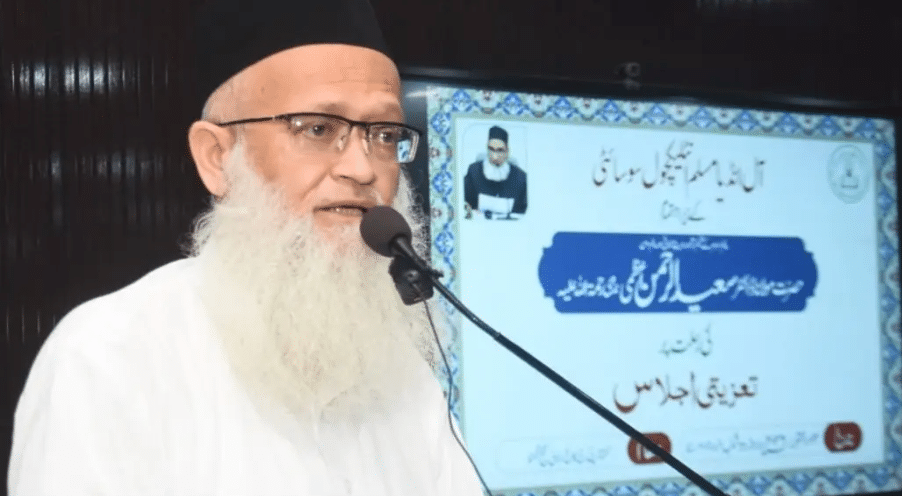
AIMIS Holds Condolence Meeting in Memory of Hazrat Maulana Dr. Saeed-ur-Rahman Azmi Nadwi Senior Islamic scholars, political leaders, academicians
*Maulana Dr. Saeed-ur-Rahman Azmi Nadwi Was a Towering Mountain of Knowledge: Maulana Bilal Hasani Nadwi*
*Preserving and Carrying Forward Maulana’s Message Is an Urgent Need of the Hour: Maulana Abdul Quddus Hadi*


AIMIS Holds Condolence Meeting in Memory of Hazrat Maulana Dr. Saeed-ur-Rahman Azmi Nadwi
Senior Islamic scholars, political leaders, academicians and representatives of diverse communities pay heartfelt tributes to the late President of AIMIS, recalling his scholarship, spiritual depth, institutional leadership and lifelong service to the Ummah._
Lucknow: The All India Muslim Intellectual Society (AIMIS) organised a solemn condolence meeting at the Maulana Rabey Hasan Nadwi Smart Seminar Hall of Mumtaz P.G. College, Daliganj, Lucknow, to commemorate the life, scholarship and multifaceted services of its late President, Hazrat Maulana Dr. Saeed-ur-Rahman Azmi Nadwi (Rahmatullahi Alaih).
A spiritual guide, an exceptional teacher, a wise preacher, a prolific writer, an eloquent orator and a respected institutional leader, Hazrat Maulana was, above all, a compassionate elder whose presence brought knowledge, warmth, reassurance and spiritual inspiration into the lives of countless people. His passing marked the loss of a distinguished scholar whose influence extended far beyond the institutions he served, touching generations of students, scholars, intellectuals and members of the wider Muslim community.
The gathering brought together prominent Islamic scholars, academicians, educationists, political leaders, social workers, intellectuals and representatives of different religious and professional communities. Speakers recalled the remarkable life, profound scholarship, humility, spiritual qualities and multifaceted services of Maulana Azmi Nadwi, paying rich tributes to his lifelong contributions to the Holy Qur’an, Islamic scholarship, education, journalism, the propagation of faith, social welfare and the wider Muslim Ummah and Islamic world.
Particular emphasis was placed on his longstanding association with and contributions to Darul Uloom Nadwatul Ulama, Al-Ba’ath Al-Islami, Integral University, the All India Muslim Intellectual Society and numerous other educational, religious and social institutions. Speakers also highlighted his invaluable role in guiding individuals and organisations across India and throughout the wider world.
The programme commenced with the recitation of the Holy Qur’an by Dr. Maulana Muhammad Idris Nadwi, Secretary of AIMIS and Assistant Professor in the Department of Arabic at the University of Lucknow. The proceedings were conducted by Maulana Zaki Noor Azim Nadwi, Vice-President of AIMIS.
Distinguished Scholars, Political Leaders and Eminent Personalities Attend
The gathering was graced by Hazrat Maulana Syed Bilal Abdul Hayi Hasani Nadwi, Rector of Darul Uloom Nadwatul Ulama, Secretary of the All India Muslim Personal Law Board, General Secretary of the All India Payam-e-Insaniyat Forum and Patron of the All India Muslim Intellectual Society. Also present was Hazrat Maulana Hafiz Qari Abdul Quddus Hadi, General Secretary of Jamiat Ulama-e-Uttar Pradesh and Qazi of Kanpur.
Among the distinguished personalities were Dr. Syed Ammar Rizvi, former Acting Chief Minister of Uttar Pradesh; Mueed Siddiqui, former Uttar Pradesh Minister; Maulana Dr. Muhammad Farman Nadwi, Editor of Al-Ba’ath Al-Islami; Maulana Abdullah Makhdoomi Nadwi, the late Maulana’s son-in-law and one of his closest associates; and Dr. Ata-ur-Rahman Azmi, his son and Assistant Professor at Khwaja Moinuddin Chishti Language University.


Other prominent attendees included Prof. Mushir Hussain Siddiqui, former Head of the Department of Arabic at the University of Lucknow; senior Congress leaders Aamir Haider, popularly known as Chacha, and Arshad Azmi; Dr. Amjad Saeed, Nazim of Jamaat-e-Islami Lucknow; Dr. Kalbe Sibtain Noori, Director of Unity College; Maulana Saif Abbas Naqvi, President of the Markazi Shia Chand Committee; Shakeel Khan, President of the Uttar Pradesh Samajwadi Minority Sabha; and Maulana Sufiyan Nizami, spokesperson of the Islamic Centre of India, among many others.
Maulana Dr. Muhammad Farman Nadwi Presents a Comprehensive Account of His Life and Legacy
Delivering the first major address following the Qur’anic recitation, Maulana Dr. Muhammad Farman Nadwi, a close disciple and longtime companion of Hazrat Maulana Dr. Saeed-ur-Rahman Azmi Nadwi, presented a detailed account of the late scholar’s life, intellectual development and enduring contributions to Islamic scholarship.
Tracing Maulana Azmi Nadwi’s distinguished family background, Maulana Farman recalled the scholarly, religious and literary services rendered by his father, grandfather, brothers and uncles. He explained how this rich intellectual and spiritual heritage was carried forward by Maulana Azmi Nadwi, whose own contributions extended far beyond the boundaries of his family tradition and secured him a distinguished place in the wider history of Islamic scholarship in India and the Islamic world.
Maulana Farman particularly highlighted the circumstances surrounding the establishment and subsequent development of Al-Ba’ath Al-Islami. He recalled the intellectual movement, historical circumstances and scholarly endeavours that led Maulana Azmi Nadwi and Maulana Muhammad Al-Hasani (Rahmatullahi Alaih) to develop the journal into an influential platform for Islamic thought, scholarship and intellectual engagement.
He also spoke at length about Maulana Azmi Nadwi’s services to Nadwatul Ulama, his contribution to the development of Integral University and the different stages through which his educational and intellectual mission evolved. He described him as a scholar whose work transcended institutional boundaries and whose influence extended across generations of students, scholars and educational institutions.
Maulana Abdullah Makhdoomi Recalls the Final Days of the Late Scholar
One of the most moving accounts of the gathering was shared by Maulana Abdullah Makhdoomi Nadwi, the late Maulana’s son-in-law and one of his closest companions. Having remained by his side for decades and been intimately involved in his daily care and affairs, he offered a deeply personal recollection of the final days of a scholar whose life had been devoted to knowledge, faith and service.
Speaking with visible emotion, Maulana Abdullah recalled that, in his personal impression, Hazrat Maulana appeared to have begun preparing for his departure from this world two or three days before his demise.
“He repeatedly looked towards his books and towards members of his family with an unusually emotional gaze. He touched various things around him and called his children to him. Although there was no apparent need, he had his nails trimmed, his beard and hair properly groomed and wore clean, fresh clothes,” he recalled.
Maulana Abdullah further explained that the late scholar had been suffering from severe illness for several months and had, because of his condition, even required the use of a diaper. Yet, at the time of his death, he appeared remarkably fresh, clean and dignified.
He observed that the condition in which Maulana Azmi Nadwi departed from this world left a profound impression upon those who were present. For them, the experience remained a deeply moving memory, reflecting the dignity and purity with which he had lived his life.
Dr. Ata-ur-Rahman Azmi Recalls His Father’s Principles as a Scholar and Administrator
Dr. Ata-ur-Rahman Azmi, son of the late Maulana and Assistant Professor at Khwaja Moinuddin Chishti Language University, recalled several deeply personal incidents that illustrated his father’s extraordinary sense of duty, discipline, integrity and commitment to institutional principles.
One such incident occurred during his student days at Nadwatul Ulama, when he suffered from typhoid and was running a high fever. When his father saw him, he first enquired about his health, displaying the natural concern of a loving parent.
However, Dr. Ata-ur-Rahman recalled that his father immediately turned to the matter of institutional responsibility.
“But immediately afterwards, in his capacity as the Principal of the institution, he asked me whether I had informed my supervisor that I was ill and staying at home. When I said I had not, he instructed me to go and inform my supervisor and obtain the proper leave,” he recalled.
The incident, he explained, demonstrated how his father never allowed his personal relationship with his son to interfere with his institutional responsibilities. Even when dealing with a member of his own family, he upheld the rules and discipline that applied equally to everyone.
Dr. Ata-ur-Rahman also recalled an important conversation that took place after he completed his M.A. from Jamia Millia Islamia and returned home. His father asked him about his future plans. In response, he explained that, since Integral University—of which Maulana Azmi Nadwi was the Founder-Chancellor—had developed from an institute into a university, he might consider joining it.
His father, however, firmly rejected the suggestion
“He told me very clearly that none of his children should ever consider taking personal advantage of any institution that he had helped establish. He said that these institutions belonged to the community and were a trust of the Ummah, not a family inheritance. Whatever had been established was the community’s amanah and would remain dedicated to the community,” Dr. Ata-ur-Rahman recalled.
He explained that this principle was among the clearest reflections of his father’s character. It demonstrated his complete detachment from personal or familial claims over institutions established for the service of the community. For Maulana Azmi Nadwi, institutions were not private possessions or instruments of family advancement; they were trusts whose purpose was to serve the Ummah and future generations.
Maulana Syed Bilal Abdul Hayi Hasani Nadwi Describes Him as a Towering Mountain of Knowledge
In his presidential address, Hazrat Maulana Syed Bilal Abdul Hayi Hasani Nadwi described Hazrat Maulana Dr. Saeed-ur-Rahman Azmi Nadwi as “a towering mountain of knowledge.”
He observed that the passing of Maulana Azmi Nadwi had caused an immense loss not only to Nadwatul Ulama, Al-Ba’ath Al-Islami and other prominent organisations with which he had been associated, but also to the entire Muslim Ummah and the wider Islamic world. The departure of such an eminent scholar and intellectual, he said, had created a profound void that would be extremely difficult to fill.
Paying rich tribute to the late scholar’s services and legacy, Maulana Syed Bilal Abdul Hayi Hasani Nadwi described him as the very spirit and driving force of the movement of Darul Uloom Nadwatul Ulama.
He observed that Maulana Azmi Nadwi was, in the truest sense, a “living embodiment of the Nadwa movement”—a scholar whose life, personal conduct and lifelong commitment reflected the ideals, educational philosophy and mission of Nadwatul Ulama.
He was not merely associated with Nadwatul Ulama; rather, he was one of its most authentic voices and a true representative of its intellectual and educational vision. His devotion to the institution was reflected not only in his formal responsibilities but also in the consistency of his work, the principles he upheld and the generations he helped guide.
Maulana Bilal Abdul Hayi Hasani Nadwi further observed that throughout his life, Maulana Azmi Nadwi had remained deeply devoted to the institution and its mission. He had, in the truest sense, fulfilled his responsibilities and honoured his commitment to Nadwatul Ulama, leaving behind a legacy of dedication, scholarship and service.
Maulana Saif Abbas Naqvi Praises His Concept of Institutional Trusteeship
Maulana Saif Abbas Naqvi, President of the Markazi Shia Chand Committee and a prominent Shia scholar, particularly endorsed the principle recalled by Dr. Ata-ur-Rahman Azmi concerning the late Maulana’s approach to institutional responsibility.
He observed that Maulana Azmi Nadwi’s declaration that institutions created for the community could never be treated as personal or family property represented an exceptionally high standard of public morality, selflessness and institutional integrity.
According to Maulana Saif Abbas Naqvi, this principle reflected a rare understanding of the responsibilities entrusted to those who establish and lead educational and social institutions. Such institutions, once created for the benefit of the community, must remain dedicated to their original purpose rather than become instruments of private or familial advantage.
He remarked that personalities possessing such clarity of principle, moral strength and selflessness had become increasingly rare, making the late Maulana’s example especially significant for contemporary society.
Maulana Hafiz Qari Abdul Quddus Hadi Calls for the Preservation of Maulana’s Message
Maulana Hafiz Qari Abdul Quddus Hadi, General Secretary of Jamiat Ulama-e-Uttar Pradesh and Qazi of Kanpur, emphasised the importance of preserving the teachings, values and intellectual legacies of distinguished religious scholars.
He observed that a community remains on the path of goodness as long as it keeps alive the names, teachings and legacies of its sincere scholars and leaders. Remembering such personalities, he suggested, must go beyond expressions of grief and must include a serious effort to understand, preserve and carry forward their messages.
Expressing concern over the departure of distinguished scholars and community leaders one after another, he stressed the increasing importance of ensuring that younger generations learn from their lives, character and contributions.
He also highlighted the responsibility of organisations such as AIMIS in preserving and disseminating the intellectual and moral legacy of personalities like Maulana Azmi Nadwi. Such efforts, he indicated, are essential to ensure that the lessons of their lives continue to guide future generations.
Shakeel Khan Nadwi Recalls Maulana’s Guidance in Public Life
Shakeel Khan Nadwi, President of the Uttar Pradesh Samajwadi Minority Sabha, expressed deep sorrow over the passing of Maulana Azmi Nadwi and recalled the guidance he had provided in public and political life.
He observed that the absence of Maulana Azmi Nadwi’s guidance would be deeply felt, particularly by those who had benefited from his balanced counsel, wisdom and concern for the welfare of society.
He highlighted the importance of the late scholar’s thoughtful guidance at a time when communities require principled leadership, mutual understanding and a sincere commitment to public welfare.
Dr. Ammar Anis Nagrami Recalls a Five-Generation Bond of Affection and Scholarship
One of the most deeply personal tributes of the gathering was offered by Dr. Ammar Anis Nagrami, General Secretary of AIMIS, who described the passing of Maulana Azmi Nadwi not merely as a loss to the Muslim community but as a profound personal and family bereavement.
Dr. Ammar explained that his family had maintained a close relationship with the late scholar for more than seven decades, spanning five generations. This longstanding association, rooted in scholarship, affection, respect and spiritual guidance, had developed into a bond that went far beyond the ordinary relationship between a scholar and his admirers.
Recalling the scholarly links between the two families, Dr. Ammar spoke of his grandfather, the renowned Qur’anic exegete Maulana Muhammad Owais Nagrami (Rahmatullahi Alaih), who had taught Tafsir to Maulana Saeed-ur-Rahman Azmi Nadwi at Nadwatul Ulama. In the subsequent generation, Dr. Ammar’s father, Prof. Muhammad Yunus Nagrami (Rahmatullahi Alaih), studied Arabic under Maulana Azmi Nadwi at the same institution.
Thus, the relationship between the Nagrami family and Hazrat Maulana had continued across generations, combining the transmission of knowledge with enduring personal affection.
“After my father’s demise, Hazrat continued to guide me at every stage. He accepted the responsibility of serving as President of the All India Muslim Intellectual Society and was also among the founding figures associated with AIMIS. His relationship with our family continued with the same affection across generations,” Dr. Ammar said.
He added that the late Maulana had shown immense affection towards his son, Ahmad Nagrami, and had continued to guide him as well. He also recalled that Maulana Azmi Nadwi had chosen the name of his granddaughter, further deepening a relationship that had extended across five generations.
For Dr. Ammar, these memories represented a legacy of affection and guidance that had accompanied his family through successive generations and different stages of life.
“From generation to generation, year after year, this relationship only became deeper. With his departure, I once again feel orphaned,” Dr. Ammar said emotionally.
His words reflected the personal dimension of a loss that could not be measured solely through the late scholar’s institutional positions or public achievements. For his family, Maulana Azmi Nadwi had also been a source of reassurance, affection, wisdom and guidance whose presence had become an integral part of their lives.
AIMIS Initiates a Series of Programmes to Preserve His Legacy
While recalling the life and legacy of Hazrat Maulana Dr. Saeed-ur-Rahman Azmi Nadwi, Dr. Ammar Anis Nagrami informed the gathering that the All India Muslim Intellectual Society had initiated a series of programmes and intellectual tributes immediately following his demise. These initiatives were intended to preserve, document and disseminate the late scholar’s remarkable legacy.
He explained that, soon after Hazrat Maulana’s passing, a special Friday khutbah and address dedicated to his life and services had been delivered by Maulana Azad Nadwi at Masjid Al-Ibrahimi, Agha Mir, Lucknow. The address focused on the late scholar’s outstanding contributions to Islamic scholarship and community service.
This was followed by a session of the Society’s weekly Dars-e-Qur’an, conducted by Prof. Dr. Muhammad Idris Nadwi. During the session, the Qur’anic scholarship and services of Hazrat Maulana were discussed in detail, with particular attention to his lifelong contribution to the study, teaching and dissemination of the Holy Qur’an.
Dr. Ammar further explained that the condolence gathering itself formed part of this continuing series of commemorative programmes. He announced that, Insha’Allah, a commemorative book would also be published shortly under the auspices of AIMIS, documenting the life, scholarly contributions and multifaceted services of Hazrat Maulana Dr. Saeed-ur-Rahman Azmi Nadwi.
The proposed publication would include tributes, personal reflections and condolence messages from leading Muslim scholars, intellectuals and prominent personalities. Its purpose would be to preserve for future generations a comprehensive record of the late Maulana’s profound impact on Islamic scholarship, education and the wider Muslim community.
Through these initiatives, AIMIS seeks to ensure that the memory of Hazrat Maulana is preserved not merely as a record of his distinguished life but also as a source of learning, inspiration and guidance for those who follow him.
Tributes from Political, Academic and Social Circles
Several other speakers also expressed their grief and recalled different aspects of the late scholar’s personality, intellectual achievements and services to society.
Mueed Siddiqui, former Uttar Pradesh Minister; Prof. Mushir Hussain Siddiqui, former Head of the Department of Arabic at the University of Lucknow; Dr. Yasir Ansari, Head of the Department of Urdu at Mumtaz P.G. College and Joint Secretary of AIMIS; Dr. Masihuddin, President of Masih Society and Librarian at the Lucknow Campus of Maulana Azad National Urdu University; Maulana Sufiyan Nizami, spokesperson of the Islamic Centre of India; Dr. Amjad Saeed, Nazim of Jamaat-e-Islami Lucknow; and senior Congress leaders Arshad Azmi and Aamir Haider also expressed their condolences.
The speakers remembered Maulana Azmi Nadwi’s scholarship, simplicity, intellectual courage, dedication to the Qur’an and Sunnah, commitment to education and journalism, and lifelong concern for the social and moral advancement of the Muslim community.
Their tributes reflected the breadth of his influence across different sections of society. His life and work had earned the respect of religious scholars, academics, political representatives and social leaders, demonstrating that his contribution extended beyond a single institution, discipline or community organisation.
Condolence Messages from Maulana Khalid Rashid Farangi Mahali and Prof. Syed Wasim Akhtar
A condolence message from Maulana Khalid Rashid Farangi Mahali, Chairman of the Islamic Centre of India and Imam of Eidgah, was also conveyed at the meeting.
As Maulana Khalid Rashid was travelling for Umrah, he sent his message from the holy journey, expressing profound grief over the passing of Maulana Azmi Nadwi and describing his demise as a deeply personal loss.
A message from Prof. Syed Wasim Akhtar, Chancellor of Integral University, was also conveyed. He expressed deep sorrow over the demise and recalled his personal association with the late scholar, as well as Maulana Azmi Nadwi’s contribution to the development of education and the university.
Similarly, Maulana Jahangir Alam Qasmi, President of Anjuman Falah Darain, who was unable to attend the meeting due to illness, sent his son, Maulana Salman Siddiqui Nadwi, with a message of condolence.
Through his message, Maulana Jahangir Alam Qasmi paid tribute to the late Maulana’s religious, educational and intellectual services and expressed his deep appreciation for his lifelong contribution to the Muslim community.
These messages further reflected the esteem in which Maulana Azmi Nadwi was held by prominent scholars and institutional leaders who were unable to attend the gathering in person.
Distinguished Gathering Pays Tribute to a Life of Knowledge and Service
The condolence meeting was attended by a large number of scholars, intellectuals, educationists, political and social figures, and representatives of various institutions and sections of society.
Among those present were Maulana Syed Ammar Hasani Nadwi, Secretary of Nadwatul Ulama, Lucknow; Insiram Ali, former Chairman of the Uttar Pradesh Minorities Commission; Siraj Mehdi, former Member of the Legislative Council; Advocate Badrul Hasan; and Qamar Ali, former member of the Uttar Pradesh Madarsa Board.
The gathering also included senior journalists Tauseef Hussain and Najum-ul-Hasan; Naveed Ahmad, Secretary of We Help Foundation and an educationist; Dr. Devendra Srivastava, Principal of Narwadeshar Degree College; and Dr. Dinesh Chauhan, Principal of Adarsh Degree College.
Among the social activists and other prominent personalities present were Murtaza Ali Siddiqui, Hammad Waheed, Imran Qureshi, Ejaz Rizvi, Hasan Mateen, Hammad Nagrami, Ali Anis, Tayyab Nagrami, Muhammad Khalid, known as ISHU, Advocate Aslam, Hafiz Misbah Nadwi, Maulana Nauman Akhtar Nadwi, Dr. Sarwat Taqi and Maulana Najibul-ul-Hasan Nadwi, besides hundreds of other distinguished personalities from different fields of Lucknow.
The broad participation of religious scholars, academics, political figures, social workers and representatives of different institutions underscored the respect enjoyed by Maulana Azmi Nadwi across diverse sections of society.
A Collective Resolve to Carry Forward His Legacy
The gathering concluded with a renewed resolve to preserve and advance the intellectual, educational, religious and humanitarian legacy of Hazrat Maulana Dr. Saeed-ur-Rahman Azmi Nadwi (Rahmatullahi Alaih).
Participants emphasised the importance of ensuring that his message of knowledge, faith, service, integrity and community welfare continued to reach future generations. The discussion also reinforced the responsibility of educational and intellectual institutions to document the contributions of distinguished scholars and translate their teachings into meaningful guidance for contemporary society.
The meeting served not merely as an expression of grief but as a collective acknowledgement of the extraordinary legacy left behind by a scholar whose influence extended across institutions, generations and diverse sections of society.
Through the heartfelt tributes, personal recollections and commitments expressed on the occasion, the gathering reflected the enduring place of Maulana Azmi Nadwi in the intellectual and spiritual life of the community. His scholarship, devotion, humility, institutional integrity and compassionate guidance remain central to the memories of those who knew him, learned from him or benefited from his work.
As AIMIS continues its efforts to document and disseminate his life and contributions, the hope expressed throughout the meeting was that the principles he embodied would continue to inspire scholars, students, institutions and community leaders for generations to come.